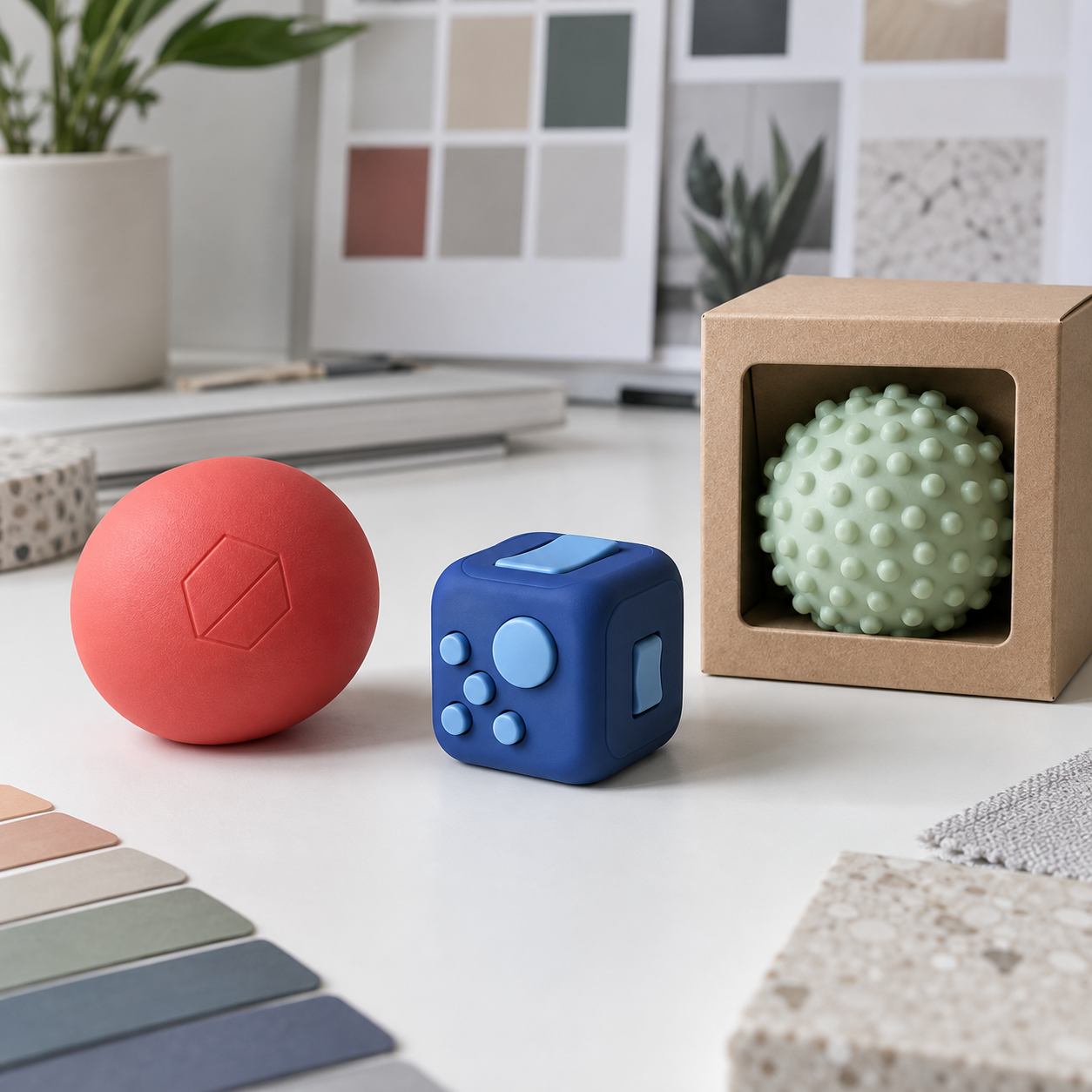
A custom stress relief toy RFQ is not a formality after the creative work is finished. It is the document that turns a reference image, a brand idea and a target quantity into a sourcing conversation that can be quoted, sampled and inspected. The strongest RFQs do not pretend every decision is final. They distinguish approved requirements from open questions, so a supplier can respond with the right technical and commercial follow-up.
1. Define the product scope before asking for a final price.
Buyers often begin with “we need a custom stress ball” or “we need a branded fidget toy.” That is enough to start a discovery conversation, but not enough to compare production proposals. The first step is to clarify whether the programme can begin from an existing format or whether it needs a new shape, a new component arrangement or a distinct packaging presentation.
Starting from an existing product direction usually reduces the number of variables. You can focus on colour, logo treatment, pack presentation and the quantity required for the launch. A more original form may be the right choice for a flagship campaign, but it requires additional decisions around tooling, sample development, surface detail, decoration area and timing. Neither route is automatically better; the useful choice is the one that fits the commercial objective and the available development window.
Describe the intended application in plain language. A wellness giveaway, a retail novelty item, a desk accessory and a premium gift-set insert can all use a tactile product, but they create different requirements for perceived value, branding, packaging and distribution. State whether the product is intended for adults, a general consumer audience or children, and identify the destination market early. Product and compliance decisions should be evaluated for the exact product and market, not inferred from a broad factory claim.
Minimum product-scope questions
- What is the primary interaction: squeeze, click, spin, stretch, touch or visual motion?
- Can an existing product format meet the brief, or is a new form essential?
- What quantity is needed for the first order and any follow-on programme?
- Which market, sales channel and user group does the product need to serve?
2. Build an RFQ that a supplier can actually quote.
A useful RFQ gives suppliers enough information to identify the commercial route, without forcing the buyer to invent technical details they do not yet know. Put the product reference or product family first. Then state the target quantity, destination market, desired delivery date, branding direction and packaging expectation. If a decision is still open—such as whether the product will use a card, box or bulk pack—say that clearly.
Separate the base product from the custom elements. For example, identify the preferred colour direction, logo location, print or surface expectation, and any individual packaging requirements. This makes it easier to see which elements affect sample work, setup, minimum order, pack size or final pricing. When a product uses multiple parts, note the desired colour allocation for each part rather than sending a single broad colour reference.
The RFQ should also identify the information you need back. Ask for a product description, quotation basis, sample route, estimated development questions, packaging options and document availability relevant to your market. Do not ask a supplier to “include all certificates” without naming the product and market. Documentation should be reviewed against the selected SKU, material, age grading and destination-market requirement.
Practical RFQ rule: a supplier should be able to understand what is fixed, what is preferred and what still needs a recommendation after reading the first page.
3. Use sampling as a decision gate, not a photo opportunity.
A sample is where a digital concept becomes a physical product. It is the right time to check hand feel, colour interpretation, visible finish, shape proportion, logo placement and how the product sits in its proposed packaging. Factory testing and in-process checks later in the order are more effective when the buyer has already identified the characteristics that matter at sample stage.
Agree the purpose of the sample before it is made. Is it a rough development sample to confirm shape direction? Is it a decorated sample to approve branding? Is it a packaging sample for retail presentation? These are different approval gates. A rough sample may be enough to decide whether the interaction is right, but it is not a reliable benchmark for final print quality or carton protection.
Keep a written approval record. Annotated photos, a colour reference, agreed artwork and a list of visible acceptance points are more useful than a general email saying “looks good.” The record does not need to be bureaucratic; it needs to make the approved version visible to the buyer, factory and any inspection team later in the process.
Ready to format your brief?
Send the product direction, quantity and target market first. We will help identify the missing questions.
Use the enquiry form to start a structured OEM / ODM conversation with FidgetZen.
4. Align branding and packaging before the order becomes urgent.
Branding and packaging should not be treated as an afterthought. A logo must work with the available product area, the desired visual hierarchy and the surface finish. A retail pack must protect the product, communicate the right information and fit the route to market. These decisions also affect the quote: a custom printed card, barcode label, insert or display box can have a different setup, minimum order and lead-time implication from bulk packing.
Ask for the packaging route in the same conversation as the product. Will the buyer repack in the destination market, ship direct to ecommerce fulfilment, hang the item on a retail fixture or include it in a gift set? Each route creates different requirements for unit protection, label placement, master-carton marks and shipment inspection. “Retail-ready” is not one specification; it is a set of practical decisions.
For brand assets, provide the best artwork available and name the approval owner. If a colour must match an internal brand reference, explain the reference system and the acceptable degree of variation. If the logo must remain readable on a curved or textured surface, flag that as a priority. A supplier can then advise where the product geometry creates limitations rather than discovering them after artwork has been approved.
For an overview of the development flow, visit the FidgetZen OEM / ODM page. It is designed to help buyers organise material, colour, surface and packing decisions into one sequence.
5. Compare cost and delivery assumptions on the same basis.
Custom product quotations are only comparable when the assumptions match. Before comparing unit prices, check the product direction, quantity, decoration, packaging level, Incoterm, freight responsibility and requested delivery window. A lower number may exclude a setup cost, a required pack component, a testing assumption or a sample stage that another proposal includes.
Ask what happens if the quantity changes. Some minimums relate to the base product, while others relate to colour, decoration, packaging or tooling. It is better to understand these thresholds before artwork is finalised than after a campaign date has been announced. If the first order is a market test, explain that. A supplier may be able to recommend an existing format or packaging route that keeps the first programme more practical.
Shipment inspection should also be discussed as part of the delivery plan. Agree who needs final photos, what pack and carton points will be checked, and when an inspection report is required. This closes the loop between the RFQ and the finished shipment: the buyer can see whether the requirements recorded at the start are still visible at dispatch.
6. Prepare the production handover after the sample is approved.
Approval is not the end of the buyer’s work; it is the point to turn decisions into a handover that production, quality and packing teams can use. The handover should identify the approved product reference, final artwork, unit-pack layout, order quantity, target delivery window and the acceptance points that must be checked. It prevents a team from treating an early concept image as a final instruction when a later sample or artwork proof has changed the direction.
For a retail programme, include any display or installation preparation needed at the destination: for example, whether the unit pack must hang, sit in a counter display or enter a campaign kit. For an ecommerce route, record label locations, pack protection and the information the fulfilment partner needs. These are product-application decisions, not generic logistics language, and they should be confirmed before the final packing window.
Customer requirements are easiest to preserve when one current document is shared with the people who need it. That can be a concise approval sheet rather than a complicated manual. The important thing is that the production team, the buyer and any third-party inspector see the same version. When questions arise, the group can refer back to the agreed source instead of relying on an old email chain.
A practical production-handover file
- Approved product and packaging photographs with version dates.
- Artwork and logo-placement files, plus any colour or finish notes.
- Quantity, unit-pack, inner-pack and master-carton requirements.
- Factory testing, sample-check and shipment-inspection points that are material to acceptance.
- Named buyer contacts for artwork, product and final packing approvals.
This level of preparation is particularly valuable for repeat orders. It gives the next production run a credible operating reference while leaving room to document any deliberate changes in product, packaging or market requirements.
FAQ
Common RFQ questions for custom stress relief toys.
What is the difference between private label and OEM / ODM for stress relief toys?+
Private label commonly starts with an existing product direction and applies your brand, colour or packaging. OEM / ODM work can involve broader changes to the product direction, decoration, packaging or product-development route. The workable scope depends on the specific product and order brief.
Should I ask for a quote before I request a sample?+
You can do both, but the quote should be understood as preliminary until the product, decoration, pack and delivery basis are aligned. A sample conversation helps turn a broad quote into a more comparable one.
What files should I send for a custom logo project?+
Send the best available brand artwork, colour references, logo-placement intent and packaging requirements. If files are incomplete, explain what is still being decided so the supplier can identify the next approval points.
How do I compare custom toy quotations fairly?+
Normalize the product direction, quantity, Incoterm, decoration, packaging, testing assumptions and delivery requirement. A lower unit price is not comparable if it excludes a required setup, pack element or inspection step.
A good custom RFQ reduces the cost of uncertainty.
The purpose of an RFQ is not to make a product seem more complicated. It is to organise the product, customisation, packaging and delivery decisions so the supplier can offer a realistic route forward. Start with the buyer need, make customer requirements explicit, use samples to approve the physical experience, and record the points that need to survive factory testing and shipment inspection.